
The story of the Milanese brand and designer and co-founder Roberto Ricci in a book.
David the jeweler versus Goliath the Big Brand. Because, according to Roberto Ricci, who founded and manages the small Rubinia boutique in Milan, it’s necessary to wage a battle of wills to defend the artisanal goldsmith’s skill, which produces jewelry with soul, versus the mass-produced pieces churned out with laser machines by large manufacturers. It’s probably a dream, because more structured companies can achieve economies of scale that are impossible for artisanal production. However, artisanal production has a more direct and emotional connection with jewelry buyers.

A philosophy that Ricci has infused into a book that tells his story and that of the Rubinia boutique. And that’s not all. The battle to defend artisanal jewelry creators is, according to Ricci, also necessary to curb the trend of jewelry store closures, which are steadily decreasing in Italy. Until 1985, Italy was the world’s leading jewelry producer, with centers of excellence in Vicenza, Naples, Milan, Valenza, and Arezzo. It’s still a business worth over €6 billion a year (the value of sales in Italian jewelry stores), but the industry is helping to destroy it. In fact, jewelry stores, like all high-street shops, have begun to close. They’ve been shuttering 20 a month for two years.
According to the designer, jewelers have forgotten that they sell emotions; “they no longer know how to create empathetic relationships with the customer.” Furthermore, there’s a shortage of artisans: schools train workers for the industry. “And we must recognize that generational change is also an obstacle. Young people don’t grasp the allure of handling precious metals to make the most important moments in the lives of those who wear them memorable.”

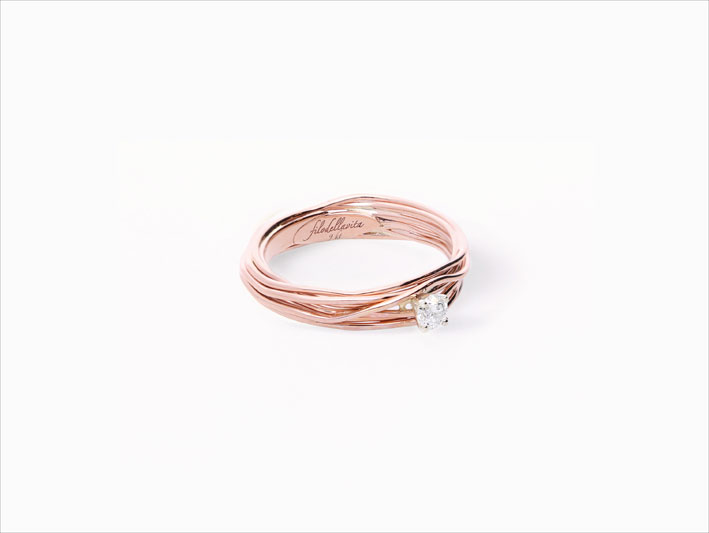
Forty years after Rubinia’s birth, Ricci’s book retraces the stages of her history. The brand was born out of a professional disappointment, after leaving Leader Line in 2004, a company (no longer active) that he had led and that had ousted him. After a stint as president of Casato Gioielli, Ricci, together with designer Ilario Plazzi, promoted Rubinia’s business, which moved from Santa Margherita Ligure (Genoa) to Milan. This activity continued with the launch of the Filodamore line, which, over time, became as iconic as the Filodellavita line since 2007, or the Numeri e Parole line. Rubinia currently has 15 employees and operates several workshops in and outside Milan, creating a network of approximately 60 businesses. The flagship store is located in Milan, at Via Vincenzo Monti 26 (with its own workshop, offices, and a lab). There are 350 points of sale in Italy and approximately 80 in France.

Roberto Ricci, entitled Rubinia – History of a Jewel. 40 Years of Love, Art, and Business, 40 chapters, 322 pages, €16.90, published by Davide Falletta and available from Feltrinelli, Amazon, and other platforms, including an eBook. Proceeds will go to the Cara&Bottega project, a Milanese hub for artisan goldsmiths.