The Egypt of the Pharaohs reinterpreted in a large collection of high jewelry from the Maison.
Napoleon’s France deserves credit for deciphering hieroglyphics thanks to the Rosetta Stone. But Van Cleef & Arpels can claim to have brought the allure of ancient Egypt to the highest levels of jewelry. The Maison’s Fascinations d’Égypte collection, whose name proclaims the underlying theme of its 180 creations, is clear from its name. Van Cleef & Arpels has adopted motifs from Pharaonic Egypt since its founding in 1906. The culmination of this passion for Egyptian culture and history coincided with Howard Carter’s discovery of Tutankhamun’s tomb in 1922, fueling the so-called Egyptomania. In tune with popular interest, Van Cleef & Arpels created Art Deco-style jewelry decorated with Egyptian symbols: sphinxes, scarabs, lotus flowers, hieroglyphics, and scenes from everyday life.
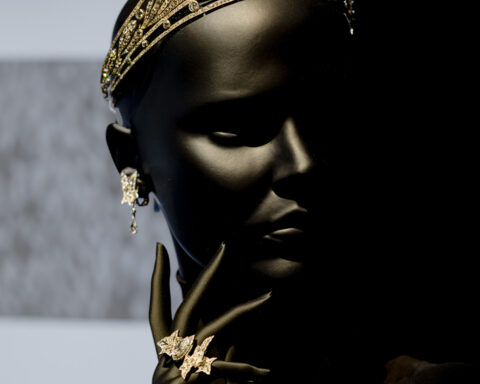
During the 20th century, the Egyptian royal family also became clients of the Maison. Van Cleef & Arpels created jewelry for Princess Fawzia of Egypt and Queen Nazli Sabri, cementing a relationship that continues to inspire contemporary creations.
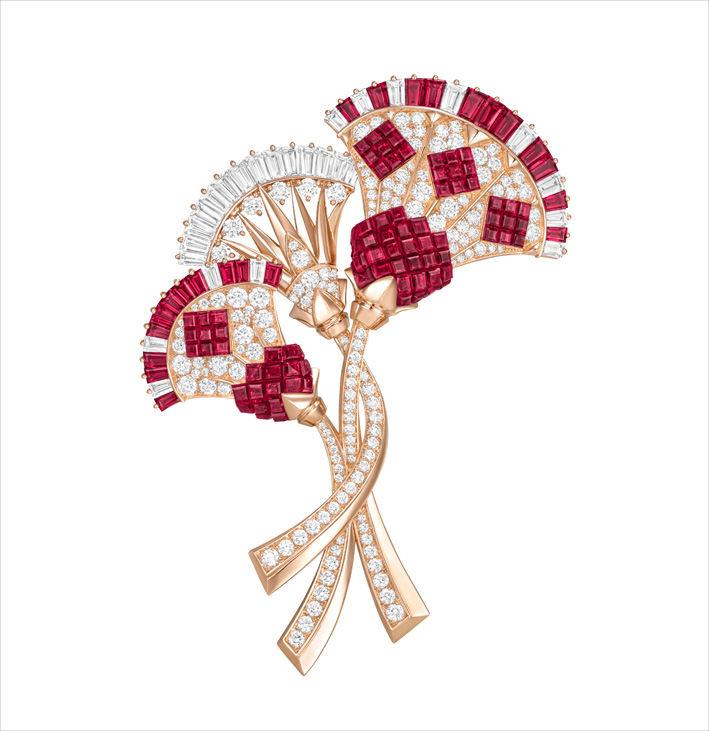
The Fascinations d’Égypte high jewelry collection uses a wide variety of precious and ornamental stones, such as rubies, emeralds, sapphires, diamonds, tourmalines, rubellites, lapis lazuli, turquoise, and rock crystal. The gems recreate the color palette used in frescoes and artistic works from the era of the pharaohs: the blue of the sky and the gods, the green of vegetation, the yellow of the sun, the red of strength, and the black of fertile earth. The stones were selected for their rarity and ability to evoke emotion and wonder. These colors blend in the jewelry interpreted by the Maison’s artisanal excellence.
The Collection
The jewelry, in addition to featuring Van Cleef & Arpels’ trademark, the famous Mystery Set, patented in 1933, which completely conceals the claws beneath the pavé-set stones, introduces hand-engraved, chiseled, and three-dimensional details that transform some pieces into miniature sculptures. Each piece also features a hieroglyphic cartouche reproducing the Van Cleef & Arpels monogram, as a final tribute to Egypt.

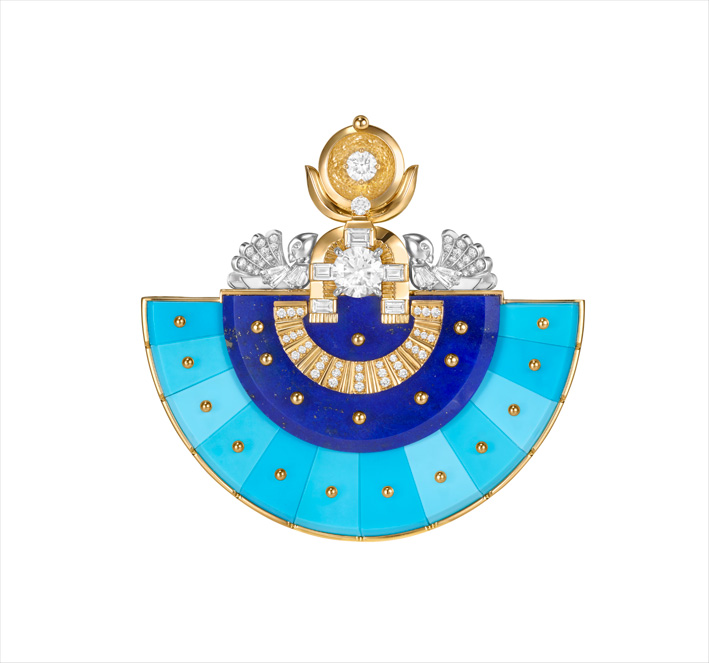
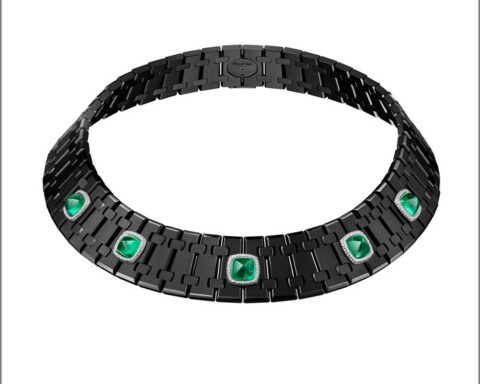
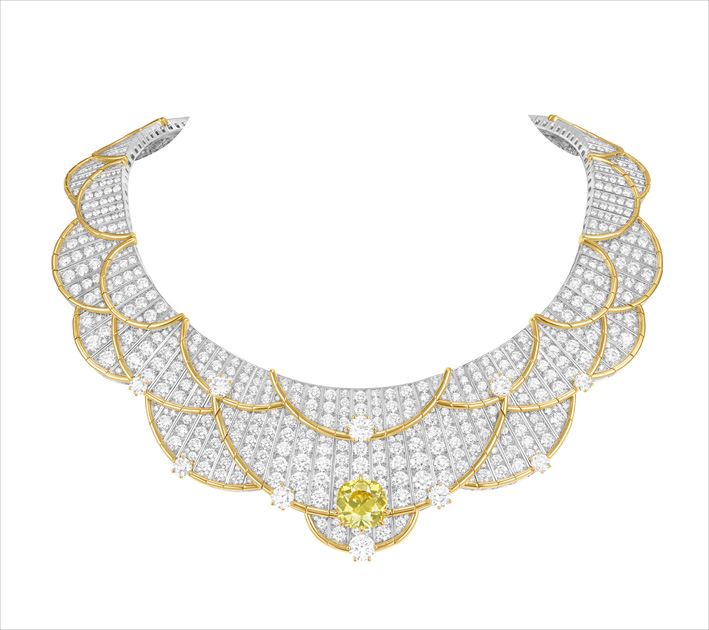
Among 180 pieces, including necklaces, rings, earrings, brooches, bracelets, and a table clock inspired by symbols and figures of Egyptian civilization, several masterpieces stand out. These include Fleur de Lotus Mystérieuse, a brooch dedicated to the lotus, a fundamental symbol of Egyptian iconography. Or Beauté Légendaire, a necklace that reinterprets the royal breastplates of ancient Egypt.
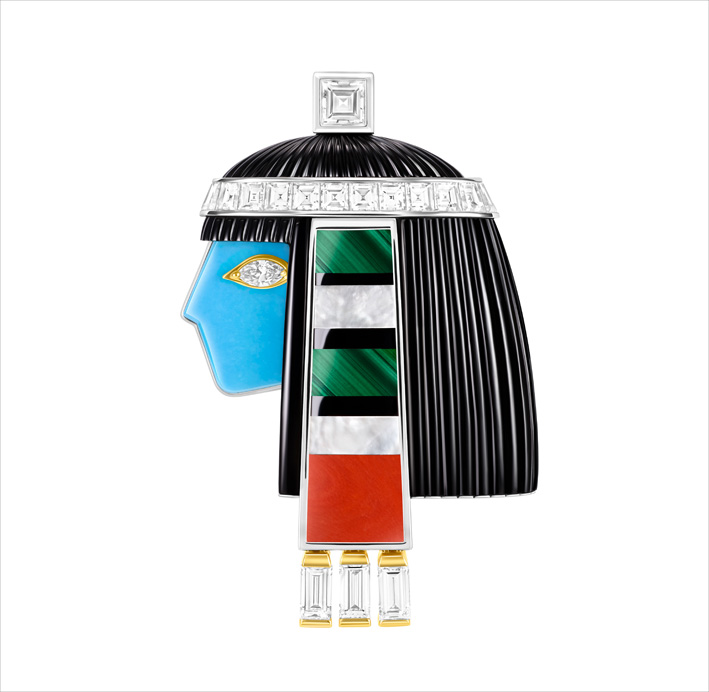
Eternal Muse and Sacred Pharaoh are two brooches depicting Cleopatra VII and a pharaoh, respectively, while Mysterious Benu depicts the bird representing the soul of Ra, accompanying the god on the solar boat. According to myth, Bennu created itself in a fire, in the form of a gray heron. The brooch features a 4.08-carat oval spessartite garnet, set in a movable setting, and a spinel with an intense red glow. The warm, vivid sparkle of the stones illuminates the piece, whose hues range from green to blue.

There are also bracelets depicting a landscape of pyramids, with pharaonic masks in pop art colors and successions of columns reminiscent of the colonnades that adorned ancient temples. The creations are directly inspired by the Egyptian-style band bracelets produced by the Maison in the 1920s. On the visible side, sculpted gold motifs juxtapose different textures: engraved, hammered, polished, or fluted. These metallic elements are surrounded by faceted gems with polished surfaces, like micro-mosaics.
Among the necklaces, Déesse Ailée Mystérieuse is a transformable jewel with large removable diamonds in rose, white, and yellow gold: two 14.05 and 2.07 carat DFL Type 2A pear-shaped diamonds, hand-set rubies using the Mystery Set technique, rubies, and diamonds.
Rings
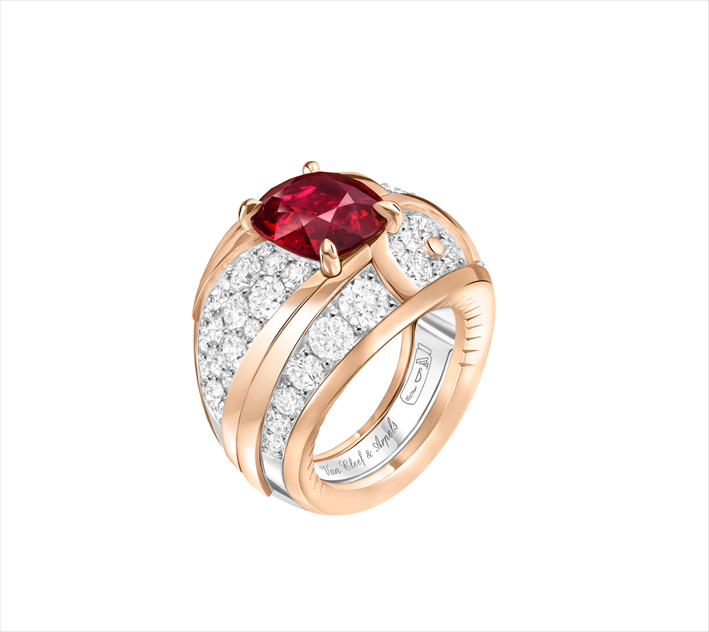
Van Cleef & Arpels continues its exploration of hieroglyphic symbols with a trio of cocktail rings: Origine de l’eau, Origine florale, and Origine du soleil. The characters designating the different elements become stylized motifs that unfold over a pavé of snow-set diamonds. On all three pieces, these designs extend on both sides of the center stones. Their domed silhouettes are crowned by an 8.71-carat sapphire from Sri Lanka, an 8.02-carat emerald from Colombia, and a 5.04-carat ruby from Mozambique, respectively. These gems reveal the intensity of their color and the quality of their crystallization in generously proportioned cushion cuts. The rings’ bodies are decorated with a sunburst engraving reminiscent of the morning star, a motif found on many pieces in the collection.