
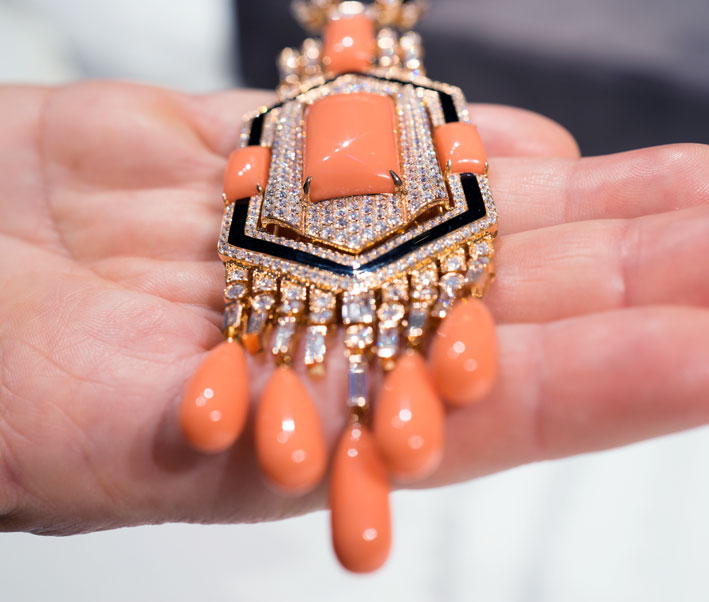
How to recognize real coral? Here’s how to distinguish real coral from imitations.
They gave you a beautiful coral necklace. But will it be real coral? Can you recognize an authentic coral from a fake when you are about to buy a jewel? How can you distinguish real coral from fake coral, usually made of glass paste, plastic, or resin? Before discovering how to recognize coral, you must of course know what coral is.

What is coral.
Everyone knows that coral before being a material for necklaces, earrings or bracelets is a living organism. Corals, for biology, are marine invertebrates of the Anthozoa class of the phylum Cnidaria. They are tiny individuals, each a few millimeters long, called polyps (but they do not have to do with the homonymous fish), which live in compact colonies. There are many types of coral. What is used for jewelry is a kind of skeleton that forms over the years, produced by the individuals who make up the community: this structure can measure up to several meters. Corals require sunlight and clear, shallow water (less than 60 meters or 200 feet). Coral is delicate and is increasingly at risk of bleaching due to stress due to the higher temperature of the water or the toxins present in the sea. Make sure your jewelry has a legitimate and sustainable origin. Among the coral types, hard corals (Madrepores) secrete large amounts of limestone and are the true “architects” of tropical reefs. Soft and precious corals have a less massive or partially flexible internal skeleton; they include species used in handicrafts, such as Mediterranean red coral.

True or false.
How to recognize a real coral from an imitation? The first rule to follow is: look for the bad part. It is not a paradox. Perfection does not exist in nature. A completely natural material will always have small imperfections which, however, signal its authenticity. Warning: a ring with a perfect coral cabochon is not necessarily fake. The jeweler may simply have eliminated the imperfections. But it is very difficult to erase any traces of what is natural, such as small spots, concentric lines similar to those of wood (they indicate the growth of the coral branch). An idea may be to take a good look at the back (if any) of the jewel, for example a ring: usually any imperfections are reserved for the hidden part.
Here are other methods to determine if coral is real or fake.
• Examination with a magnifying glass: Examine the surface with a magnifying glass. Real coral has fine longitudinal veins or small concentric circles, similar to wood grain. Plastic or glass are perfectly smooth or show air bubbles.
• Temperature test: Touch the object. Real coral is a calcareous material and feels cold to the touch, warming very slowly. Plastic feels warm immediately, while glass remains cool but lacks the typical veining.
• Sound: Gently tap the piece against a tooth or glass. Real coral emits a dull, full sound. Plastic produces a dry, “light” sound.
Chemical and destructive tests (to be performed with caution)
• Acid test (Vinegar or Lemon): Pour a drop of vinegar or lemon juice into an inconspicuous area. Real coral is made of calcium carbonate and will react by creating a slight effervescence (small bubbles). Plastic and glass do not react. Caution: Clean immediately after testing to avoid clouding the surface.
• The hot pin test: Heat the tip of a pin over a flame and press it into an invisible spot (such as the inside of a pearl hole). If it penetrates and you smell burning plastic, it’s fake. Real coral resists the heat of the pin without melting and does not give off any unpleasant odors.

Beware of fake bamboo coral
A very common deception is bamboo coral, a cheap marine plant dyed red to imitate precious coral. To spot it, rub the object with a cloth soaked in acetone or alcohol: if the cloth turns red, it’s artificial dye.

Black coral.
There is red, pink, white coral. And then there is the black coral. But, in reality, the latter does not belong to the same family as the others. What is called black coral is a marine plant (gorgonacea) that grows among the waves of the sea in the area of the equator. Coral, on the other hand, as we have seen, is made up of thousands of small polyps. Black coral, which is often dark brown, is a very hard plant that can be worked on. Be careful not to mistake this material for real coral. Incidentally: black coral is not uncommon (as some would have us believe) and has a rather low value.

The angel skin.
One of the traps of dishonest jewelers is to sell fake angel skin coral. This is the name of a rare variety of Satsuma compact pink coral, of Japanese origin: the fewer white spots it has, the better the quality. This type of coral has a particular characteristic, which helps to recognize it immediately: it costs a lot, figures with three zeros. Therefore, a jewel with a lower price is not angel skin, but simple pink coral. Nice, but that’s another thing. By the way: precisely because angel skin coral is so rare, it is usually sold with a guarantee certificate: better ask for it.







Ich suche eine schwarze Korallenkette mit 25 Korallen Mit 2cm Durchmesser. Beste Qualität. Wissen sie was.
Sorry Bernhard Christian, aber wir machen keinen Online-Verkauf, dies ist eine Informationsseite. Viel Glück!