GemGèneve is back (8-11 May), an event that offers a look at vintage jewellery, new designers but, mainly, large precious and semi-precious stones. There will be around 200 traders from Asia, America, Australia and all over Europe present in pavilions 1 and 2 of the Palexpo in Geneva. The event, accompanied by a series of training and culture events on jewellery and gems, is also an opportunity to look closely at extraordinary gems and, perhaps, even make a purchase. For this reason, the organisers of GemGèneve have asked some participants for a contribution that could be useful to visitors, even the less experienced ones (GemGèneve is open to the public). The first content is written by Nicolas Torroni and his son Constantin of Tim & Co, in Geneva, a brand specialising in exceptional stones, pearls and antique jewellery, which also makes jewellery pieces. Nicolas Torroni is recognized in the industry as one of the rare specialists in the work of Alfredo and Giacomo Ravasco, Milanese jewelers active in the last century. Constantin worked alongside his father Nicolas Torroni: at 27 years old, he embodies the Generation Y of GemGenève dealers and the sixth generation of salesmen of the Torroni family. A graduate of the GIA, Constantin is also fortunate to be able to count on the precious advice of his brother Alexandre and his father.

7 TIPS ON HOW TO BUY JEWELS WITH CONFIDENCE
Constantin Torroni, Nicolas Torroni
#1 Trust your eye
And your gut feeling! The most important thing when you first look at a jewel is to note its shape, brilliance and colour. Before looking at a diamond’s certificate, you need to trust your eye; do you like it?
#2 Choose the right lighting
Lighting plays a key role when you’re examining a jewel. Daylight will reveal a coloured gemstone’s natural hues; artificial light will have an effect on how different highlights look. Ideally, try and view the stone in different lights to gauge the full extent of its brilliance.
#3 Check the overall condition
If the stone is already mounted, the setting may conceal imperfections or chips. Viewing the stone through a loupe should be second nature; that way you can be sure of noticing any defects. If
you’re not yet much of a connoisseur, don’t hesitate to ask the seller about this type of issue. They’ll undoubtedly invite you to examine the piece using a loupe.
#4 Check the hardness index
Some stones such as emerald and apatite are fragile and delicate. Others such as tanzanite and opal aren’t good at withstanding temperature fluctuations, and may break or crack. Researching
gemstones’ hardness and other properties is a good way of knowing what you’re buying.
#5 Please do touch
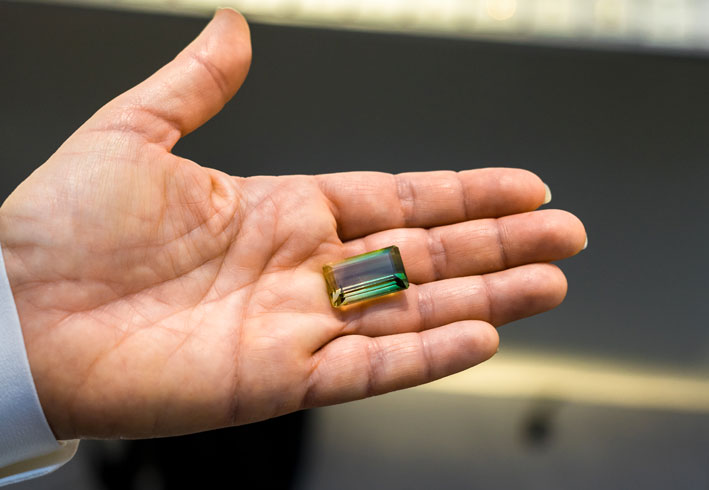
Gemstones should be touched as well as looked at, and a jewel dealer’s job is very much bound up with touch. If you’re buying a stone, you should pick it up; in doing so, you can examine the resulting interplay of light.
#6 Don’t rule out any colour
Some customers are looking for a diamond offering excellent value for money; I recommend what I call ‘charming stones’, my term for the opposite of an ‘investment diamond’. People’s first instinct with diamonds is to go for D, E and F stones, the highest grades on diamond colour charts corresponding to the whitest diamonds, often commanding the highest prices. However, some diamonds graded G or even H may be of high quality and be more attractive than one might think, and as such be a more strategic alternative : they are less affected by speculation and their value holds up better during times of crisis.
#7 Seek a second opinion
It may be worth asking the opinion of a connoisseur to see whether your intuition and gut feeling are on the right track. For me, working with other family members is a real asset in this respect. If I want to know what somebody else thinks about a stone, I can ask my father or Alexandre, my brother.