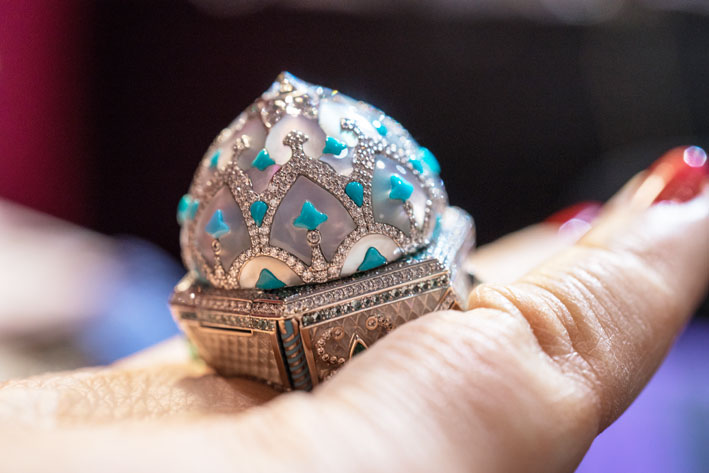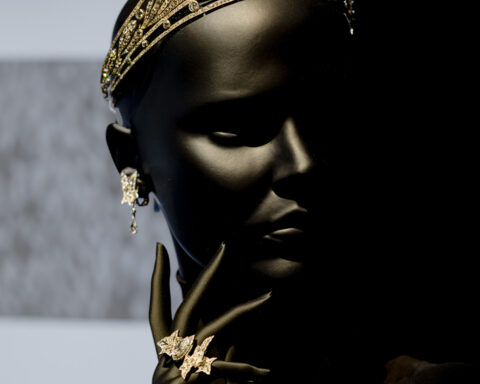

For Alessio Boschi, jewelry is also a journey through the history of culture and art, translated into elaborate creations that always offer surprises. Two examples suffice to describe his goldsmithing virtuosity combined with his passion for revealing historical figures, architecture, and styles. One is the collection, appropriately named Historica. The most striking piece in this line is the Golestan Palace ring, inspired by a building constructed in the 16th century in Persia, now Iran, renovated in the 18th century, and finally rebuilt in 1865. It is the former official Qajar royal complex in Tehran.

To illustrate this architectural gem, the ring features a finely carved emerald at the top. The gem is set in Iranian turquoise (the highest quality) with a decorative 22-karat gold motif. There’s no shortage of surprises: the ring opens to reveal a chain with seven miniature Persian carpets, all enameled, which fold and rest on a throne. The carpets represent the ancient provinces that produced the Peacock Throne.

Another example of storytelling involves the figure of Marco Polo, a trader, explorer, and writer (born in Venice on September 15, 1254, and died January 8, 1324). His description of his travels in the Far East is collected in the literary work Il Milione, which brings together essential knowledge of Asia, and China in particular, to Europe at the end of the 13th century. He even served as an advisor and ambassador to the court of the Great Khan Kublai. For centuries, Il Milione has inspired generations of European travelers, such as Christopher Columbus.
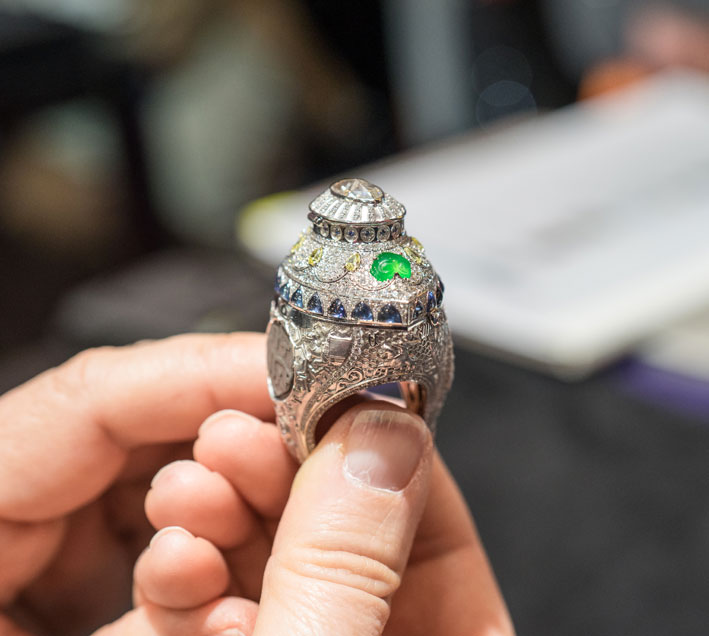
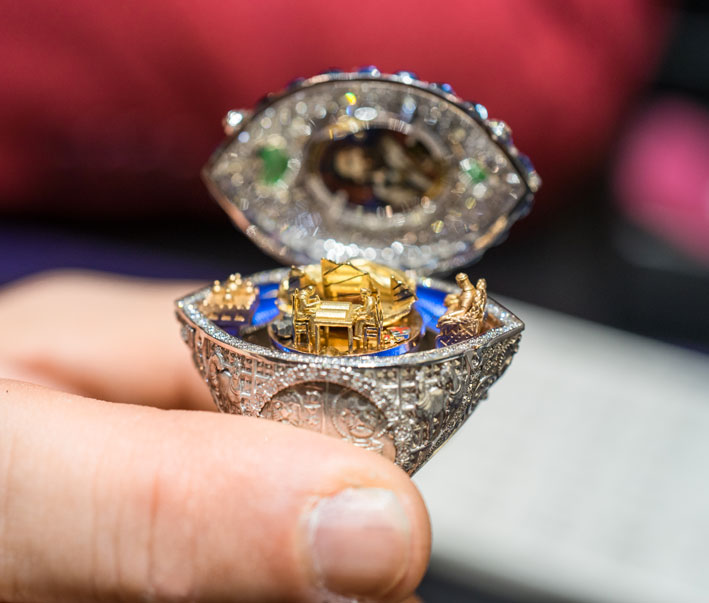
Alessio Boschi has drawn inspiration from Marco Polo with a jewelry collection. Among the pieces in the collection is a ring that took over four months and 30 people to make. The ring embodies Marco Polo’s image: it recalls the ship on which the explorer set out, architectural elements of St. Mark’s Basilica in Venice, and original 13th-century coins: one depicts St. Mark presenting the standard to Doge Lorenzo Tiepolo. Another is inspired by the Khanate of the Golden Horde. Hidden inside the ring is a micromosaic portrait of Marco Polo by Roman artist Luigina Rech, which doubles as a pendant for a necklace. The back features a symbol combining Chinese and Italian elements for good luck.

But that’s not all: at the center is a marquise-cut diamond, surrounded by arches that recall Persian, Indian, Byzantine, and Moorish art, the cultures traversed by the merchant-explorer. Near the arches are two imperial jades and eight yellow diamonds. At the bottom, 4-carat Ceylon sapphires surround the ring.

Inside the ring, which opens with a click, in addition to the necklace featuring Marco Polo’s portrait, there’s another surprise: scenes from his life and journey, crafted in gold: the ship sailing to the East, his encounter with Kublai Khan on the throne, and his return to Italy, with Marco Polo dictating his memoirs, which would become Il Milione, to Rustichello da Pisa, who actually wrote the book. A jewel, in short, that is also a story, a game, and a journey.