
All about topaz, one of the most mysterious stones. It is also the stone of the month of November ♦
It is the stone of the month of November (with citrine), but the topaz is also one of the gems coveted since antiquity. There is, however, a point against him: if it is blue shade is often confused with other stones less valuable, as aquamarine and apatite. Other times, the topaz is mistaken for smoky quartz or citrine. Care must be taken, therefore, because often a simple quartz is sold as topaz. And to say that the topaz can be just as precious as diamonds or sapphires.

The name topaz
It’s called topaz for centuries. But what does the name? According to some, the term dates back to a small island in the Red Sea, Topazos. Here the Romans, according to this version, extracted the stones called, precisely, Topazos. Too bad, in real world they are not on topaz on island, but the stones are now classified as peridot. So much so that the island nowadays has changed its name: it is called Zabargad, which in Arabic means just peridot. The misunderstanding, however, is not solved. So? Another version traces the name topaz to Sanskrit, the classical language of ancient India. In Sanskrit, the word topas means fire. The mystery continues.
Composition of topaz
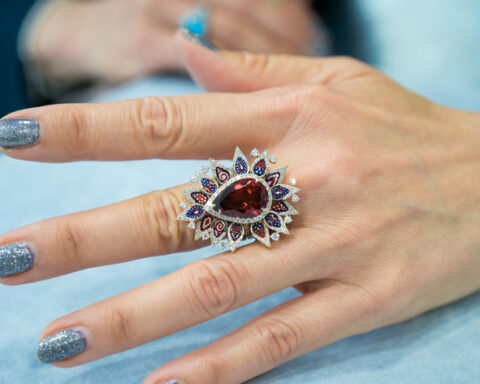
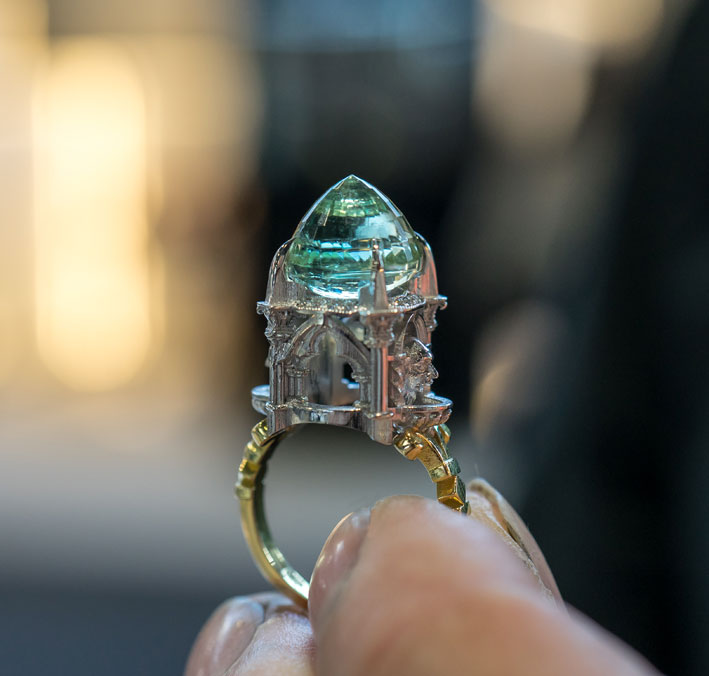
The topaz is from a geological point of view a silicate mineral of aluminum and fluorine. It is crystallized in prism shape, ending in pyramidal faces. Chemically, the aluminum silicate is highly similar in structure to the zircon. In theory, the topaz is a mineral allocromatico, that is pure is colorless. In fact, it is often found with traces of chromium, manganese or iron. These elements are those that stain the topaz, turning red, pink, blue-green, blue (natural), pink-orange, yellow-brown, yellow-orange (cherry), yellow, colorless.

Topaz Colors
Blue Topaz is the most common variety on the market. Almost all blue topaz available—ranging in shades from “Sky Blue” and “Swiss Blue” to “London Blue”—is produced by subjecting originally colorless stones to irradiation and heating treatments.
Imperial Topaz is the rarest and most prized variety, characterized by warm tones ranging from yellow-orange to reddish-pink.
Some stones are coated with metallic oxides to create iridescent effects (such as the variety known as “Mystic Topaz”).

Where is it
The topaz brown, yellow, orange, cherry, red and pink, are located in Brazil and Sri Lanka. The pink topaz found in Pakistan and Russia. It is a mineral rich enough (there is even one that weighs 300 kilograms), an aspect that keeps a relatively low price. Brazil is the world’s largest supplier (and is also famous for Imperial Topaz), though the stone is also mined in Russia, Nigeria, Pakistan, the United States, Mexico, and Australia.

Characteristics
Sometimes the topaz has inclusions equivalents: according to experts, in some blue topaz you can have even the impression of a sort of floating. Attention: the color of the natural stone tends to fade in the sunlight. For this reason, a lot of topaz are treated. In some cases they are heated up to about 450 degrees celsius. In this case the topaz brown-orange get pink. Or become colorless. Another system is the radiation. Exposed to radiation from cobalt 60, topazes that are colorless or pale color, acquire a deeper shade. Experts assure that this treatment with radiation is not dangerous. Topaz has a hardness of 8 on the Mohs scale, making it a very hard, scratch-resistant stone suitable for everyday wear in rings or bracelets. However, be careful: a strong, direct blow can easily cause it to crack or fracture.

How to clean topaz
Topaz is ranked eighth on the Mohs scale, which measures the hardness of stones (in first place is the diamond ranked 10). Topaz, therefore, is a fairly hard and resistant stone. The greatest danger is that it will chip when hitting a harder material, or get scratched. But, as far as cleaning is concerned, it does not need special care. Just immerse the jewel for about ten minutes in a container with warm water and a couple of drops of liquid soap. Then, gently scrub with a soft-bristled toothbrush. Finally, it dries with a cloth.It is best to avoid ultrasonic cleaners, steam cleaning, extreme temperature fluctuations, and prolonged exposure to direct sunlight, as the latter can cause the color of some specimens to fade.